Open Grounds or Compact Venue: Which Fits Your Day?
Compare open-ground and compact-venue festivals by movement, atmosphere, and access so you can choose a setting that suits your day between performances.
The common mistake when choosing between open grounds and a compact venue is to compare only the performers. A festival’s layout shapes how easily you move between sets, where you can pause, and how much of the day feels like travel; open-ground and compact-venue festivals can make the same lineup feel very different.
Why does moving between performances become a problem?
At an open-site festival, stages may sit across fields, lawns, or a broad park. The distance between them can turn a quick changeover into a deliberate walk, especially if paths converge near a popular stage or cross uneven ground. The attraction is room to spread out; the tradeoff is that changing your mind can take effort.
A compact venue usually groups stages inside one building or within a close cluster of rooms. You may be able to move between performances with less walking, but doors, corridors, and small rooms can become pinch points. A short route is not necessarily an easy route if the crowd is flowing in the opposite direction.
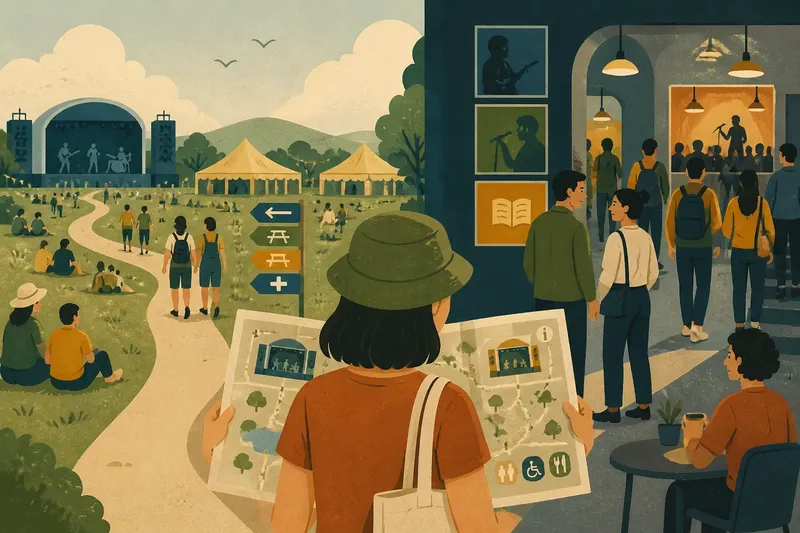
Before choosing, look for a site map and note whether the stages are separate destinations or neighboring rooms. Then consider your likely pattern: are you happy to settle in one area, or do you prefer moving as the mood changes?
What if the next stage feels too far away?
This usually happens when a site’s scale is judged from the map’s appearance rather than its walking routes. A map can flatten hills, obscure barriers, or make a long path look direct. At an open site, the route may also pass through a busy central area rather than a quiet edge.
Try checking the festival’s own map for named entrances, bridges, ramps, and one-way routes. If the map does not make the connections clear, look for access information or contact the organizer before buying. Choose open grounds if a longer walk between sets sounds like part of the day, not an interruption you will resent.
Say you want to catch a singer at a far field stage and then a spoken-word set near the entrance. If the site map shows a narrow crossing between them, you might choose the singer and stay nearby afterward rather than planning an immediate switch. The expected result is a day shaped around fewer, more comfortable transitions instead of a rushed attempt to cover the whole site.
Why can a compact venue feel crowded even with short walks?
Compact venues concentrate people in the same corridors, entrances, and indoor rooms. A popular act can fill a small space before you arrive, while people leaving one set meet those heading to another. The issue is not simply the venue’s size; it is how its shared routes handle simultaneous movement.
Check whether the event lists room capacities, timed entry, or restrictions on re-entry. These details can indicate how freely you can move among stages, but they do not tell you how a specific room will feel at a particular moment. If being able to enter a performance without a queue matters most, a broad outdoor site may suit you better—provided its stages are not tightly clustered.
For a compact venue, consider whether you enjoy choosing a room and staying there for a run of performances. If you would rather drift in and out, seek information about separate entrances and circulation between rooms. Not worth the effort: trying to infer crowd levels from promotional photos, which rarely show the busiest points of movement.
What does the setting change about a pause?
Open grounds may offer lawns, benches, or quieter edges where a break can feel like part of the outing. But those places may be exposed to sun, wind, or rain, and a quiet spot can sit far from the next stage. A site’s pause-friendly feel depends on both its seating and the distance from a place to rest back to the performances you want.
Compact venues can make it easier to find a sheltered corner or nearby café, though seating may be limited and shared with people waiting for the next set. Look at venue information for indoor and outdoor areas, food spaces, and accessible seating rather than assuming that a smaller footprint means a calmer break.
Ask yourself what kind of pause helps you return to the music: fresh air and room to sit, or shelter and a shorter trip back to a stage. That preference can matter more than the headline description of the site.
Which festival layout suits different ways of attending?
Choose a format by matching its movement to your habits, not by treating either layout as automatically easier. These questions can help clarify the fit:
Are open-ground festivals better for wandering?
They can be, especially when you enjoy exploring separate areas and do not mind walking between them. Check the map for route connections and places to pause so wandering does not depend on guessing where the next stage is.
Are compact venues better if I want to see more acts?
Shorter distances may make changing rooms easier, but capacity limits and crowded corridors can restrict access. Look at how entry to individual rooms works before assuming every nearby set will be easy to join.
Which layout is easier if I have mobility needs?
Neither label tells you enough by itself: an open site may have long routes, while a compact building may have stairs or narrow passages. Compare the organizer’s access map, route surfaces, seating, and assistance information, then ask a qualified accessibility contact about details that affect your needs.
Can a mixed indoor-outdoor festival offer both formats?
Yes, but the transitions matter: an outdoor stage and an indoor room may be close on paper yet separated by a queue, entrance check, or weather-exposed path. Check whether you must leave and re-enter a controlled area when moving between them.
How can you tell whether a site map matches your preferences?
Use the map to answer practical questions, not to plan every moment. Look for the relationship among stages, entrances, toilets, seating, food areas, and accessible routes. Notice whether the event presents walking paths clearly and whether barriers divide areas that look adjacent.
- Mark the stages you are most interested in and see whether they are grouped or scattered.
- Check for crossing points, stairs, ramps, and routes that may funnel people together.
- Look for places to sit or step away from the main flow.
- Find out whether movement between areas requires a ticket check or re-entry.
- Compare the site’s access information with the route and rest options you will actually use.
If the map leaves a question unresolved, use the organizer’s access or visitor contact rather than filling in the gap with assumptions. Rules and facilities depend on the event’s own arrangements, so confirm the relevant details there.
How should you make the final choice?
Open grounds are a stronger fit if you like outdoor space, can tolerate longer transitions, and enjoy making a day of moving between distinct areas. A compact venue is more appealing if you prefer a concentrated setting and want stages close together, while accepting that indoor bottlenecks may replace long walks.
For the best open-ground or compact-venue choice, picture an ordinary stretch of the day rather than only the performance you most want to see: leaving a set, crossing the site, finding a place to pause, and deciding what to hear next. If that sequence sounds pleasant in one format and tiring in the other, you have a more useful answer than a comparison of stage counts alone.